Only a criminal can play a criminal
Three Seconds“Only a criminal can play a criminal” is the governing maxim of Piet Hoffmann’s prison performance. It frames undercover work not as a disguise that can be maintained by documents alone, but as a role that must be made convincing through knowledge, conduct, and acceptance within the prison’s social order. The phrase’s darker implication is that a successful performance leaves its performer exposed to the same rules and dangers as the identity he has assumed.
Meaning and Function
The shorter formulation, “Only a criminal,” sharpens the claim: resemblance to a criminal is not enough; the role requires the practical competence of someone who can function as one. In context, the maxim describes the credibility Hoffmann needs to enter Aspsås prison and establish himself among prisoners. It is therefore both a rule of impersonation and a measure of its cost: the more convincingly he occupies the criminal identity, the less protection there is in treating it as mere acting.
Preparation and Entry
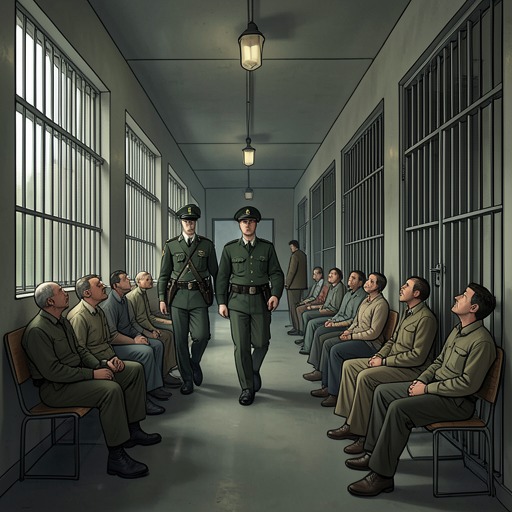
Hoffmann had not previously been inside Aspsås prison, although he had studied it from outside. From the church tower he mapped the buildings and examined the barred windows. While on remand, with Erik Wilson’s help, he learned about the prisoners and staff in the corridors of Block G. When the gates opened and the bus brought him to the prison’s central security, his first-hand entry followed this extensive preparation. The distinction between prior knowledge and actual admission gives the maxim its practical force: he must turn information about the institution into conduct that will pass within it.
Making the Role Visible
After ten days, Hoffmann learns the unit’s routine, including where to go and the seven-thirty lock-in. He also chooses how the other prisoners will first see him. Before they return, he waits in the television corner, where he can watch each arrival and be seen in turn. Rather than hide or wait for permission, he takes another prisoner’s usual chair, uses marked cards, and begins playing solitaire at the table. These are small, deliberate breaches of customary possession that present him as someone who can claim space. At supper, when two older prisoners question him, Stefan and Karol Tomasz prepare to intervene; Hoffmann signals that they should hold back and allows the questions to proceed. He understands that respect among the prisoners is being tested through their shared hostility toward sexual offenders.
The performance is supported by paperwork as well as behavior. Before Hoffmann arrives, Stefan and Karol Tomasz have circulated information about his supposed charges, associates, and standing with an Eastern European mafia. Through Stefan’s lawyer they obtain copies of criminal records, intelligence and prison records, and a recent judgment. The records give the persona an institutional history; Hoffmann’s actions in the unit give it a present-tense credibility.
The Role’s Limits
The prison’s rules continue to shape Hoffmann’s life after he has established himself. He relies on a pillow, a chair at the threshold, and a sock between the door and its frame as a means of protection, with only a brief interval in which an attacker might act unseen. Later, ten members of the prison riot squad escort him from Block G to the voluntary-isolation unit in Block C, showing how quickly his position can be altered by the institution’s control of movement and space.
The maxim does not promise that playing the role will make Hoffmann safe. The account eventually identifies one of his protectors or potential means of escape as the person who had betrayed him. That reversal turns the phrase into an irony as well as a strategy: criminal credibility helps him enter the closed world, but neither the performance nor the people tied to his protection can guarantee an exit.